
Andy Vick
RAL Space
Theme Leader

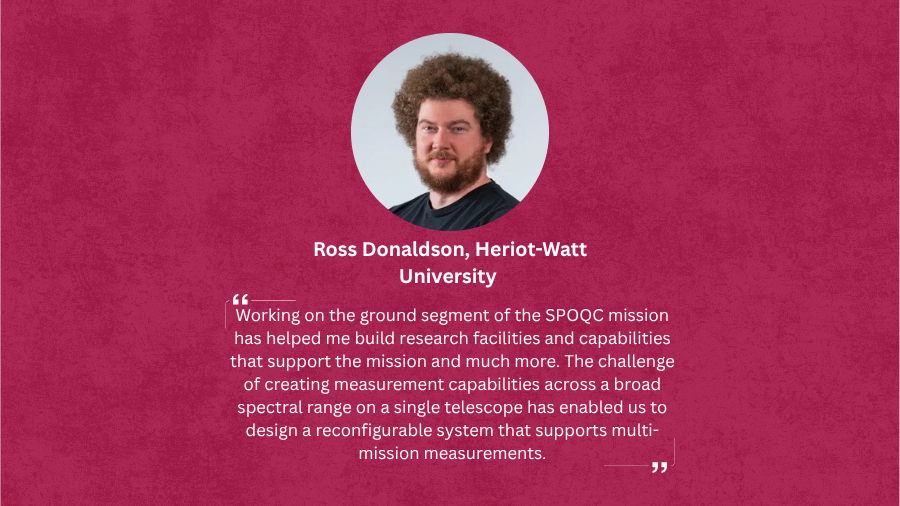
Ross Donaldson
Heriot-Watt University
Theme Co-Leader
IQN Hub is strengthening the UK’s leadership in space based quantum communications through the Satellite Platform for Optical Quantum Communications (SPOQC) low Earth orbit demonstrator, and the Hub Optical Ground Station (HOGS), which enables low Earth orbit quantum links with SPOQC and other international space missions.
Satellite-based Quantum Key Distribution (QKD) provides an elegant solution to the currently limited range of terrestrial optical fibre for key distribution, thereby extending the use of QKD from metropolitan and inter-city to international scales.
The UK has world-leading research in terrestrial optical fibre QKD, and the Hub is supporting accelerated translation of that expertise and leadership into satellite-based quantum communications. HOGS will also enable the UK to collaborate in international satellite QKD initiatives in addition to communicating with the Hub satellite.
Find out more about the different components of the SPOQC mission here:

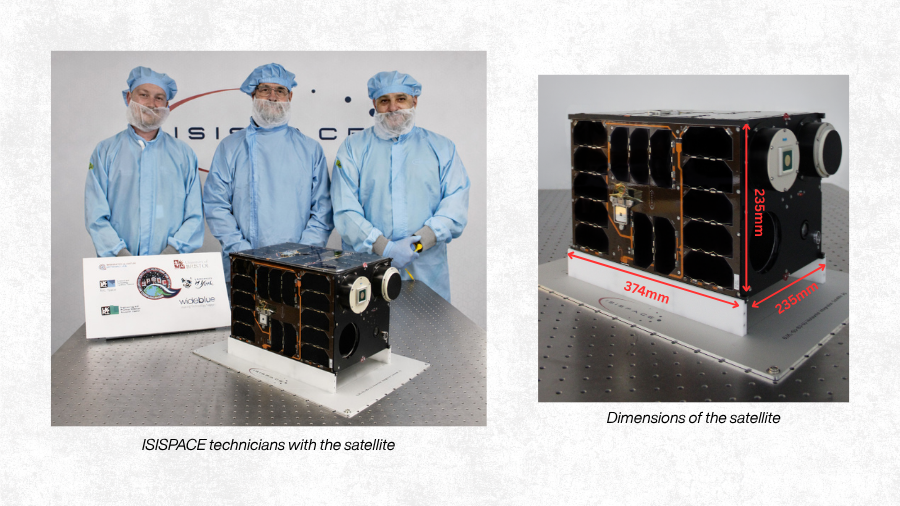
SPOQC (the Satellite Platform for Optical Quantum Communications) is IQN Hub’s 12U CubeSat which will demonstrate in-orbit quantum key distribution from space to the Hub Optical Ground Station (HOGS) at the Heriot-Watt University campus near Edinburgh, in Scotland.
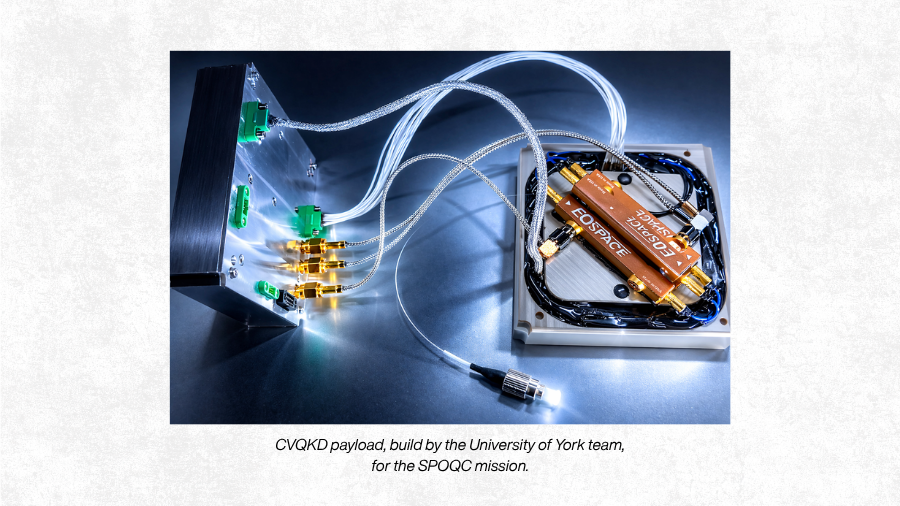
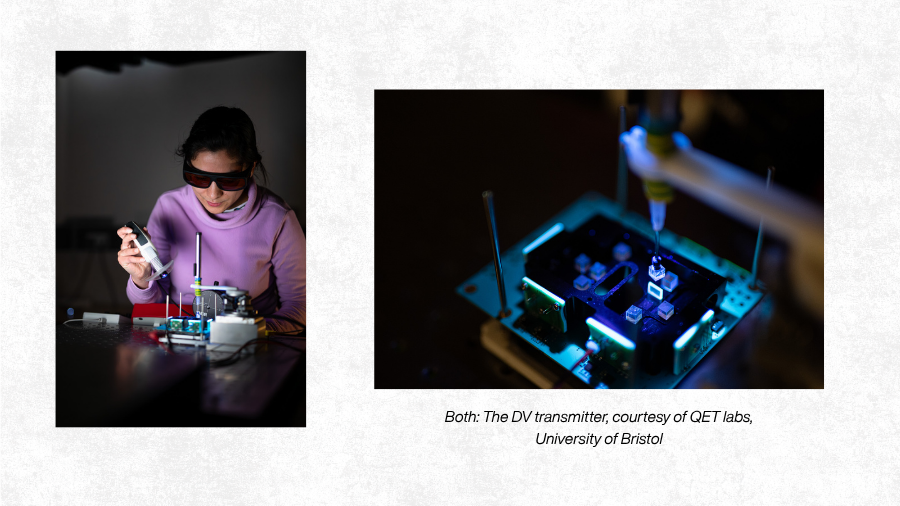
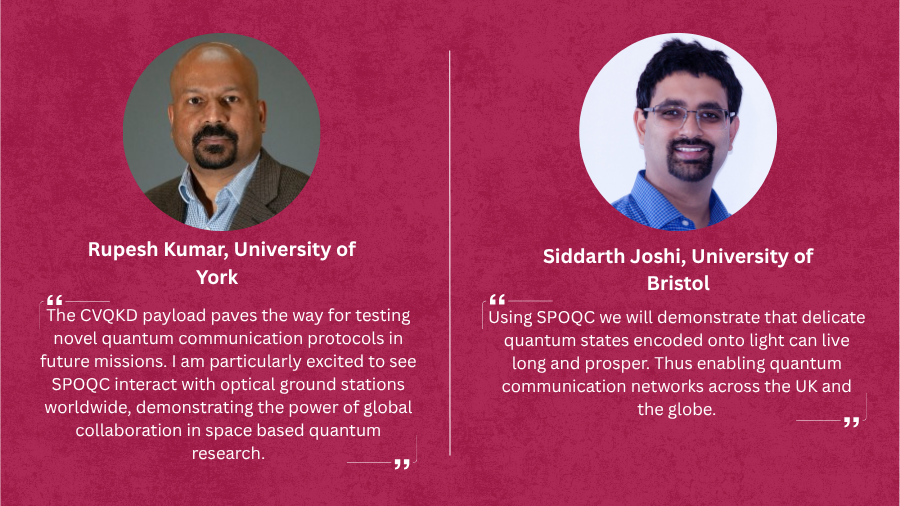
SPOQC’s quantum payloads have been developed by teams at the Universities of Bristol and York. The Science and Technology Facilities Council’s RAL Space has provided the necessary space technology expertise, with the University of Strathclyde researchers developing the necessary optimal conditions modelling.
Successful operation of SPOQC will enable us to establish the crucial next research and development steps towards future commercial quantum secure services in space.
The specific platform to be employed in the SPOQC mission is a 12U CubeSat bus. The satellite platform will be placed into a Low-Earth Sun-Synchronous Orbit (SSO), with an altitude of between 500-600 km. It will provide overpasses of HOGS twice a day, with the majority of scientific experiments taking place during the night overpass, to minimise noise from the solar background.
Dutch company ISISPACE have provided satellite systems and services in support of the SPOQC mission.
ISISPACE is one of the leading companies in the small satellite market, specialised in realising innovative turn-key small satellite missions including launch and operations for in-orbit delivery.

The SPOQC mission is unique in launching a dual quantum source, operating two “prepare and measure” protocols with two corresponding receivers built into HOGS.
The dual sources are:
– a Continuous-Variable (CV) QKD protocol developed by the University of York
and
– a Discrete-Variable (DV) QKD protocol developed by the University of Bristol
Only one source (DV or CV) will operate at any time, with the corresponding receiver being active. This is due to the battery limit of the satellite.
Overall, the payload for SPOQC is divided into:
– the Central Payload Controller (CPC)
– the Optical Transmission Alignment Module (OPTAM)
– the Downlink Laser Beacon (DLB) operating at 685 nm
– the Earth Observation Camera (EOCAM)
– the Quantum Subsystem proper
The CV source will transmit modulated quantum light pulses, alongside a reference beam for measurement. It is designed to explore the potential advantages of CV, including daylight operation, due to its wavelength of operation at 1,550 nm.

The DV source will employ weak coherent pulses (approximate single photons) in a decoy-state implementation of the BB84 (Bennett-Brassard) QKD protocol. The source will use two separate wavelengths (785 and 808 nm), in order to increase the quantum key rate through spectral multiplexing of the independent 100 MHz payload capabilities to create a 200 MHz pulse stream. The source outputs combine in a passive optical device in the satellite, before entering the OPTAM for transmission to the ground. This payload also features a 904 nm timing signal to synchronise the satellite and HOGS data.
Approximate wavelengths emitted from the satellite (these might change due to thermal conditions on the satellite and Doppler shift):
– 685 nm – Downlink beacon (polarised and unpulsed)
– 785 nm – DV-QKD wavelength (100 MHz)
– 808 nm – DV-QKD wavelength (100 MHz bandwidth)
– 904 nm – Timing beacon
– 1,550 nm – CV-QKD wavelength
Meet two of the researchers working in this area:


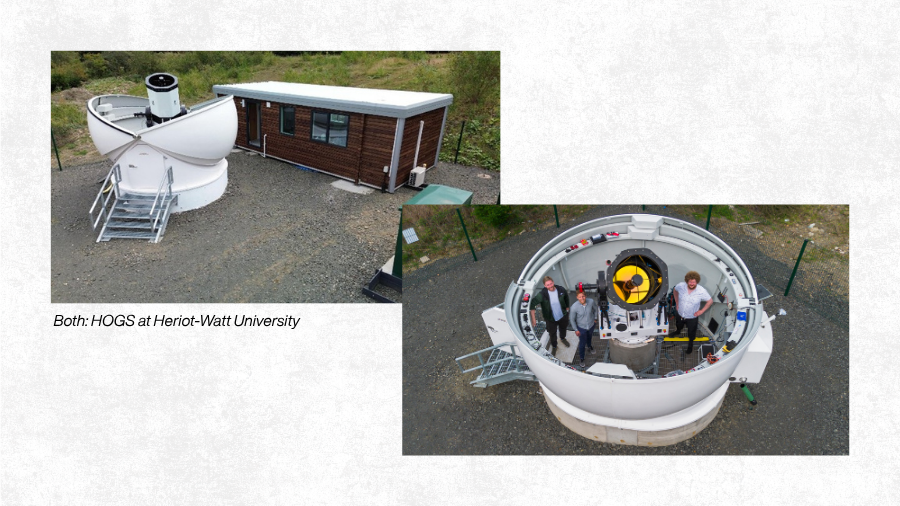
Heriot-Watt University campus hosts the state of the art Hub Optical Ground station, which complements the SPOQC mission.

HOGS consists of a robotic observatory dome Allsky 4.5m dome with base and support systems procured by BAADER together with a 70cm-wide observatory reflective telescope (RC700 design with metallic coatings, procured by Planewave), used to both track the low-Earth orbit satellite path with high precision and also receive the quantum signals.
Adaptive optics, supported with additional EPSRC funding, are being used to further enhance the telescope capability. Both HOGS and the satellite employ laser beacons to accurately point towards each other. Once they are precisely aligned, quantum communications will commence.
HOGS will utilise one of two quantum receivers, dependent upon which quantum source on SPOQC is active. DV quantum signals will be measured and analysed using photon detectors built and provided by the University of Bristol’s DVQKD payload team. CV quantum signals will be detected and analysed, against the reference beam also sent from the satellite, using a homodyne detector, built and provided by the University of York’s CVQKD payload team.
In both cases, after combination with the supporting radio frequency communications, quantum keys can be generated.
Meet one of the researchers working in this area:

The Hub’s engineering outputs in this area are supported by rigorous theoretical modelling undertaken by Hub colleagues at the University of Strathclyde.

Researchers have developed SatQuMA (Satellite Quantum Modelling & Analysis Software), a numerical toolkit that determines the finite key capacity in satellite-based quantum key distribution (SatQKD). This open-source software is being aimed at providing modelling and analysis for SatQKD missions and is available to download on GitHub.
Already this modelling work has provided valuable insight to support the Hub’s choice of an optimal site for the establishment of HOGS. Looking ahead, it is expected to contribute to analysis of further key parameters (source quality, background light, overpass geometries, etc.) and their implications on satellite QKD system design and operation, alongside establishing performance benchmarks for both sources and detectors of quantum signals in space.
Meet one of the researchers working in this area:

HOGS is a strategic research facility that is designed to outlive the Hub’s SPOQC mission and continue to be used by researchers doing similar R&D work in the UK and in collaboration with international missions. The telescope has capability for two separate optical outputs, providing excellent scope for parallel UK and international collaborative projects, involving different satellites.
One such collaborative partnership is through the Hub’s Heriot-Watt research team which is part of the international science team of the QEYSSat mission. The mission is led by the Canadian Space Agency and supported by researchers at the University of Waterloo, Canada, with whom Heriot-Watt University has a Memorandum of Agreement.
QEYSSat (Quantum EncrYption and Science Satellite) is a low-earth orbit satellite with a quantum receiver and transmitter, capable of exchanging quantum-encoded photons with a quantum ground station via a line-of-sight freespace link. A unique feature of QEYSSat, when compared to other quantum satellites, is having the main quantum receiver on the satellite. Putting sensitive detectors in space has challenges, but this satellite enables photonic uplinks in addition to downlinks, which allows testing of how new quantum sources on the ground could improve the uplink quality. There is also the potential for linking directly to terrestrial fibre-based quantum networks, using entangled photon pairs generated on the ground.
Alessandro

Alessandro Fedrizzi
Heriot-Watt University
Siddarth
Siddarth Joshi
University of Bristol
Rupesh
Rupesh Kumar
University of York
Daniel
Daniel Oi
University of Strathclyde