QNetworks 2026 – Registration now open
QNetworks is a two-day international workshop organised by the Integrated Quantum Networks (IQN) Hub.
The workshop will bring together thought leaders from similar flagship R&D initiatives across the world and key governmental and industry voices to discuss the challenges, solutions, and partnerships required to deliver the next generation of quantum networks.
QNetworks will take place on the 12–13 May 2026 in Bristol and attendance is free due to generous support by EPSRC.
The programme will include presentations on:
- Quantum memories
- Integrated photonics for quantum networking
- Enabling technologies & field trials
- The role of entanglement
- Postquantum cryptography
- Quantum communications via satellite
- Networked quantum systems for distributed sensing & computing
We are very much looking forward to welcoming researchers, innovators, and partners for two days of insight, discussion, and community-building.
You can find more information about the event and register here.
Summer School Announcement
We are delighted to announce that the IQN Hub Summer School will take place at Heriot-Watt University’s campus in Edinburgh, Scotland, from 27 June to 3 July 2027.
This immersive week-long programme will focus on the latest developments in quantum networking. Participants will have the opportunity to explore emerging technologies, engage with leading specialists in the field, and collaborate with peers from across the quantum community.
Set in the vibrant and historic city of Edinburgh, the Summer School will combine high-level scientific training with a stimulating and supportive learning environment.
Further details on the programme, speakers, and registration will be announced soon, so stay tuned!
December 2025 Newsletter
You can read IQN Hub’s December Newsletter here.
Industry Partners’ Forum
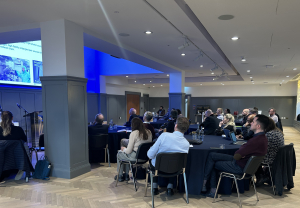
The Integrated Quantum Networks Hub hosted its first in-person Industry Partners’ Forum in Edinburgh this November. We were delighted to welcome an enthusiastic audience of formal industrial partners and external stakeholders for a day of productive discussions, networking, and exclusive updates from our research leads.
Our partner network is critical to the Hub’s mission and adds enormous value to our programme, contributing a diverse array of expertise and commercial perspectives in addition to ~£20m of additional direct and in-kind support.
We would love to talk to you if you are interested in joining our growing community and, for all those interested in regular updates on our research and activities, please sign up to our newsletter here! 
IQN Hub Outreach Event – Quantum Shorts
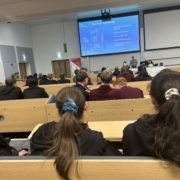
To celebrate the United Nation’s “International Year of Quantum Science and Technology”, the IQN Hub recently hosted an outreach event at Heriot-Watt University. The Hub welcomed 67 high school pupils from six schools across Scotland’s Central Belt, including two from Glasgow, for an event exploring quantum science, creativity, and future career pathways.
The event featured a screening of “Quantum Shorts” – winning entries from a global short-film competition led by the Centre for Quantum Technologies at the National University of Singapore. These films introduced pupils to quantum science in a creative and accessible way.
During the afternoon, pupils also heard from IQN Hub’s Professor Alessandro Fedrizzi and PhD student Kiki Dekkers about the exciting advances being made in quantum science, as well as what life is like as a university researcher. The session sparked lively questions and thoughtful discussion from the audience. It was fantastic to see such enthusiasm and curiosity for science from these young people.
The Hub collaborated with Heriot-Watt University’s Outreach team to deliver this event, and we look forward to continuing our partnership to further develop the IQN Hub’s outreach programme. Widening participation in quantum science is critical so that we can inspire the next generation of quantum scientists.

Shop-bought cable powers quantum breakthrough
For decades, physicists have dreamed of a quantum internet: a planetary web of ultrasecure communications and super-powered computation built not from electrical signals, but from the ghostly connections between particles of light.
Now, Heriot-Watt scientists say they’ve taken a major step towards turning that vision into something real.
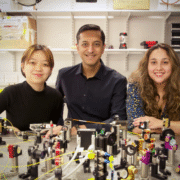
Researchers from the School of Engineering and Physical Sciences have unveiled a prototype quantum network that links two smaller networks into one reconfigurable, eight-user system capable of routing and even teleporting entanglement on demand.
“Our prototype is a network that can flexibly distribute and swap entanglement among many users, or quantum processors – it could be the breakthrough quantum computing has been waiting for.”
The demonstration, reported this week in Nature Photonics, sets a new benchmark for how large, flexible and capable quantum networks can become.
Professor Mehul Malik said: “Other teams had already demonstrated that you can build a single quantum network and send entanglement to many users at once.
“But this is the first time anyone has managed to link two separate networks together. It doesn’t just distribute entanglement in different ways, it actually lets one network talk to the other.
“This is a major milestone on the road to a real-world quantum internet.”
Using light’s chaos as a resource
At the heart of the Heriot-Watt prototype, instead of a gleaming quantum chip or custom-engineered device, is a shop-bought optical fibre that costs less than £100.
The team harnessed the scattering behaviour of light inside an optical fibre to programme their reconfigurable entanglement router.
Dr Natalia Herrera Valencia, lead author of the study, said, “Light tends to ricochet chaotically through the fibres’ hundreds of internal pathways. We turned that chaos into a resource.
The result is a reconfigurable multi-port device that can distribute quantum entanglement between users in multiple patterns, switching between local connections, global connections and mixed configurations at will.
Crucially, the system can multiplex these channels, meaning it can serve many users simultaneously, rather than one pair at a time. Multiplexing is what allows classical telecoms networks to send vast amounts of data down a single fibre using different wavelengths; here, a similar concept is deployed in the quantum regime.
Most strikingly, the team achieved multiplexed entanglement teleportation, swapping entanglement between four distant users across two channels at once. Previous demonstrations have teleported entanglement, but not across so many simultaneous users in such a flexible architecture.
Dr Natalia Herrera Valencia said: “By shaping the light at the input, we effectively programmed the fibre, transforming its messy internal scattering into a powerful, high-dimensional optical circuit.”
“That lets us route quantum entanglement wherever we want, even teleport it, using this deceptively simple piece of fibre.”
A leap for quantum computing
Professor Malik says the demonstration has exciting implications for quantum computing.
“It’s really exciting. Quantum computing could be world-changing, transforming how we find and develop medicines, create new materials for batteries and supercharge machine learning.
“A promising current approach to building a large-scale, powerful quantum computer is to interconnect lots of smaller quantum processors.
“Our prototype is a network that can flexibly distribute and swap entanglement among many users, or quantum processors – it could be the breakthrough quantum computing has been waiting for.
“Yes, this is a lab-scale demonstration, but the principle is extendable.”
The work is part of the UK’s £22m Integrated Quantum Networks (IQN) Hub, which aims to build the country’s first large-scale quantum network and help meet the government’s mission to deploy the world’s most advanced quantum network by 2035.
The research team is part of a major research and technology development consortium, the £22M Integrated Quantum Networks (IQN) Hub. Led by Heriot-Watt University, the project is funded by the Engineering and Physical Sciences Research Council (EPSRC) and brings together the expertise of 14 leading UK universities plus over 50 industrial partners to secure the UK’s leadership in quantum networking. The Hub’s vision aligns with one of the UK Government’s national quantum strategic missions, for the UK to have deployed the world’s most advanced quantum network, at scale, by 2035. This research was supported by the UK Engineering and Physical Sciences Research Council (EPSRC), the European Research Council (ERC), and the Royal Academy of Engineering. The work was carried out by Heriot-Watt University’s Beyond Binary Quantum Information Lab in collaboration with the Edinburgh Mostly Quantum Lab.
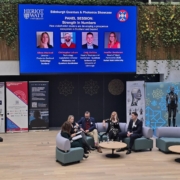
Heriot-Watt University Quantum & Photonics Showcase 2025
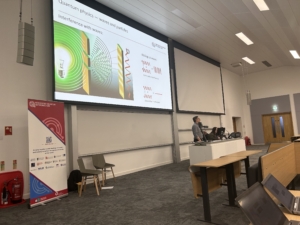
On 3 November, the IQN Hub was delighted to help organise a fantastic showcase of quantum and photonics research in Scotland with partners at Heriot-Watt University and the Quantum Software Lab (QSL) at The University of Edinburgh.
The event was a fantastic opportunity for participants to explore how Universities and industrial partners are working together to build a thriving ecosystem for innovation and economic growth across Scotland and beyond.
Alongside the main programme, representatives from the IQN Hub and QSL also welcomed an international delegation organised by the Department for Business and Trade, including visitors from Japan, South Korea, Denmark, the USA, Germany, India, and Israel.
We are looking forward to building on these discussions and exploring opportunities to strengthen and expand our international collaboration across the global quantum community.
UK National Quantum Technologies Showcase
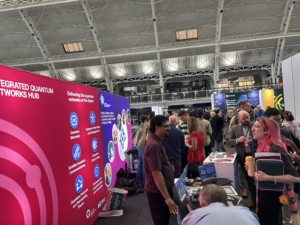
Last Friday 7th November, the IQN Hub joined leading innovators and researchers at the UK National Quantum Technologies Showcase in London’s Business Design Centre. Hosted by Innovate UK, the event welcomed over 3000 visitors keen to explore the latest breakthroughs in quantum science and technology. Our IQN team had an extremely positive and busy day, connecting with companies, investors and other academics, sharing their work on cutting-edge quantum innovations.
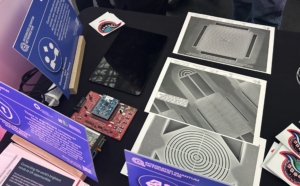
Throughout the day, we welcomed hundreds of visitors to our stand, showcasing demonstrations of the science and technology behind all six of our research themes:
- Quantum memories
- Dynamic networking and entanglement distribution
- Quantum communications in space
- Quantum components
- Quantum protocols and networking theory
- Quantum-safe secure communication & standards
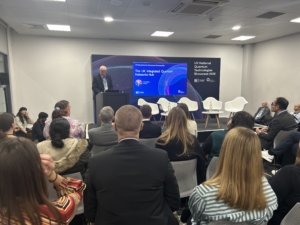
Our Director, Gerald Buller took part in an extremely popular session in the morning to discuss the UK’s five Quantum Technology Hubs – highlighting their new capabilities and how they will deliver societal impact and economic growth for the UK.
He discussed how the development of new quantum memories and interconnects through the IQN Hub will allow the distribution of entanglement across long distances, supporting the development of next-generation quantum information networks. This will integrate many of the Hub’s other hardware outputs and will be designed to be compatible with existing telecommunication/data infrastructure to facilitate widespread national-scale deployment.
The IQN Hub’s co-investigator, Christopher Chunnilall from the National Physical Laboratory, then joined industry representatives for a wide-ranging panel session that covered topics such as nurturing commercialisation and how to encourage the next generation of quantum researchers.
A key driver of each Hub’s success is its collaboration with a wide range of leading industry partners; we were delighted to meet many of the IQN Hub’s on the day to discuss how we can continue to deliver real impact together.


IQN researcher awarded IET Achievement Medal!
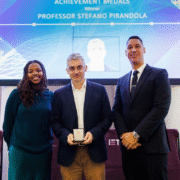
🎉 Congratulations to our researcher and co-investigator Stefano Pirandola PhD who has been awarded an IET Achievement Medal in Quantum Technology. The IET medals are awarded to individuals who have made an exceptional contribution to the advancement of science, engineering or technology.
Prof Pirandola from the University of York was awarded the medal for establishing the ultimate communication rates for quantum key distribution, quantum teleportation, and entanglement distribution.
His groundbreaking work has set the theoretical limits for secure quantum communication and made a critical contribution to building the next generation of quantum networks.