
Space mission launch advances UK standing in quantum communications
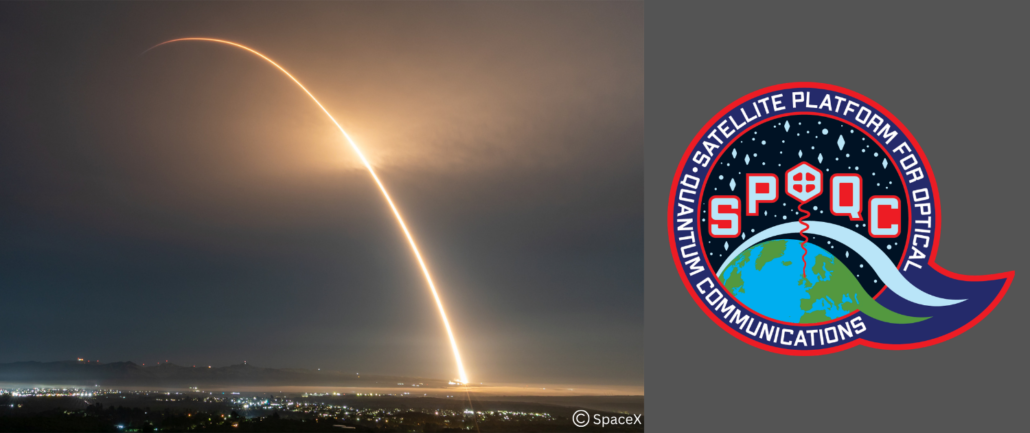
Photo Credit: SpaceX
A landmark space mission built on UK research excellence is set to accelerate progress in quantum communications, as the Heriot-Watt University led Integrated Quantum Networks (IQN) Hub launches the pioneering “Satellite Platform for Optical Quantum Communications” (SPOQC).
Emerging from research and development efforts led by the preceding Quantum Communications Hub and later advanced by the IQN Hub – both funded by the Engineering and Physical Sciences Research Council (EPSRC) – the mission brings together five UK research institutions working to strengthen the UK’s leadership in space-based quantum communications, addressing cybersecurity threats posed by emerging quantum computing technologies.
The SPOQC CubeSat was launched aboard a SpaceX Transporter-16 rocket from Vandenberg Space Force Base in California, USA on 30 March 2026. The satellite is now in the final stages of “commissioning” – the setup and performance testing – after which, it will begin transmitting quantum signals to special receivers installed on a state-of-the-art facility, the Hub Optical Ground Station (HOGS), based at Heriot-Watt University in Edinburgh.
The satellite is currently in a low Earth, Sun synchronous orbit, passing over the UK approximately twice a day. Most quantum measurements will be carried out during the nighttime passes, when conditions are optimal for the experiments.
A crucial step towards establishing secure, global quantum communication networks
Quantum secure communications are a priority of the UK’s National Quantum Strategy, which identifies quantum technologies as essential for strengthening national resilience, digital infrastructure and long-term technological competitiveness.
As quantum computers grow more powerful, traditional encryption methods will become increasingly vulnerable. Quantum communications offer a futureproofed alternative, enabling ultra secure data transfer in which any attempt to intercept the signal is immediately detectable.
Terrestrial fibre networks already support quantum communication links across the globe and including in the UK (via the UK’s Quantum Network (UKQN)). However, long distances impose real limitations, which in turn affect the quality of the quantum signals.
Satellite based systems provide the only practical route to a resilient international communication infrastructure. The SPOQC mission, alongside other international missions, will advance understanding of quantum information exchange between Earth and space, offering essential insights for building global-scale quantum secure networks.
SPOQC’s unique approach
SPOQC is an entirely UK-developed research collaboration bringing together the Universities of Bristol, Heriot-Watt, Strathclyde and York, alongside the Science and Technology Facilities Council’s RAL Space.
The satellite’s quantum sources (or transmitters) and corresponding ground receivers have been developed by teams at the Universities of Bristol and York, with the University of Strathclyde providing the necessary optimal conditions modelling. STFC RAL Space contributed space engineering, systems integration and mission support expertise, whilst Heriot-Watt University is operating the optical ground station. The mission also partnered with ISISPACE, which provided the satellite and overall technical support.
Uniquely, the mission uses a dual quantum source payload; one is based on discrete quantum signals, i.e. single photons or signals at the single photon level (built by the University of Bristol team) and the other is using continuous variable type signals, more like continuous pulses of light at the quantum level (developed by the University of York researchers). Both link to dedicated receivers within the optical ground station. This configuration allows researchers to switch between two established but technically distinct communication methods, increasing the likelihood of successful outcomes under varying atmospheric and orbital conditions.
By scaling these quantum technologies down to a 12U CubeSat (approximately the size of a microwave oven) we will demonstrate a critical proof-of-concept for future, compact, cost-efficient quantum-satellite communications. Working together with the HOGS research facility, SPOQC will pave the way for future commercialisation of space-based quantum networks.
SPOQC is the second quantum mission supported by UK research to launch in the past six months. It follows the November 2025 launch of SpeQtre, a UK-Singapore collaboration led by STFC RAL Space and Singaporean quantum technology company, SpeQtral.
Next Steps
As commissioning progresses, researchers will validate system performance, with full quantum communication experiments expected to begin in the second half of 2026.
Professor Tim Spiller from the University of York said: “As Director of the preceding Quantum Communications Hub, it is very pleasing to see six years of R&D by that Hub team to develop SPOQC and HOGS finally be rewarded with the launch of SPOQC. This will add a very important space link to the UK’s expanding quantum networking capability. I look forward to the first quantum demonstrations from SPOQC and HOGS later this year.”
Professor Gerald Buller, Director of the Integrated Quantum Networks (IQN) Hub said: “The SPOQC mission is the culmination of outstanding collaborations between leading UK Universities, STFC RAL Space, and external industry partners. It offers a world-first platform to critically compare different quantum communication modalities, including the first use of continuous variable approaches from space. Through the IQN Hub, the SPOQC mission is a vital enabler towards truly global quantum communication via integration into terrestrial UK networks.”
Andy Vick, Disruptive Technology Programme Lead at STFC RAL Space said: “The launch of two quantum CubeSats in close succession highlights the UK’s growing leadership in quantum technology. While both missions share a common satellite platform, SPOQC has united new partners to address new challenges. The RAL Space team is proud to have contributed from the outset, working closely with the Quantum Communications Hub, whose initial work laid strong foundations for the mission, and now supporting its delivery under the leadership of the IQN Hub. SPOQC is a big step for all the teams involved, one that we hope will pave the way for the UK’s national quantum network mission.”
Dr Kedar Pandya, Executive Director of EPSRC’s Strategy Directorate, said: “The SPOQC mission is a powerful example of how UK research leadership is shaping the future of secure global communications. By uniting worldclass expertise across our quantum research hubs, we’re demonstrating not only scientific excellence but real technological ambition. This launch marks a major step toward quantum-secure networks that will help safeguard the UK’s digital infrastructure for decades to come.”
