The UK Integrated Quantum Networks Hub
  • Home
  • Research
    • Quantum Memories
    • Dynamic Networking and Entanglement Distribution
    • Satellite Quantum Communications
    • Quantum Components
    • Quantum Protocols and Networking Theory
    • Quantum-safe Secure Communication & Standards
  • Partners
  • People
    • Leadership Team
    • Research Team
    • Operations Team
  • News
  • Events
  • QNetworks 2026
  • Contact
  • Menu Menu

Heriot-Watt breaks ground on new £2.5M Optical Ground Station

28 August, 2024

Work has started on a new Quantum Communications Hub Optical Ground Station (HOGS), a state-of-the-art telescope which is being built on Heriot-Watt University’s Research Park.

The new facility will demonstrate and test satellite quantum secure communications, maintaining and growing the UK’s strength in the field of quantum technologies. It is scheduled to be fully operational by late Autumn [2024].

As well as helping to tackle future cyberattacks by researching methods to send secure transmissions via satellites, it will unlock new research on space environmentalism alongside innovative R&D activities for future laser communication networks. These provide high bandwidth communications services like 6G and beyond.

The facility will feature a plethora of cameras, sensors, and other photonic technologies enabling HOGS to expand how it can be used for both UK-based and international researchers and industry contacts. HOGS will also be directly connected to a new University campus optical fibre network, being developed alongside HOGS, allowing innovative teams to demonstrate deployment of optical, quantum, and hybrid communication networks.


“We want to show that UK scientists have the capabilities to deliver satellite quantum-based communications and have the expertise to do all the required operations. Creating secure global connectivity is the goal.” Dr Ross Donaldson


Space environmentalism and public engagement

The new capabilities will support space environmentalism by finding debris, accurately tracking satellites and developing new techniques to find objects that haven’t been seen before and improving the identification of what the object is. The telescope may also open opportunities for teams to explore new de-orbiting techniques for small space-debris using lasers.

The facility is being built as part of the Quantum Communications Hub project, funded through the UK National Quantum Technologies Programme and is part of a collaborative effort which also involves the Universities of Bristol, Strathclyde, and York. Space engineering expertise is provided by the Science and Technology Facilities Council’s RAL Space Facility.

Other UK researchers with relevant interests in experimental satellite quantum communications will be invited to work onsite using the modern telescope to track satellite paths with high precision. Heriot-Watt students, from undergraduate to PhD, will benefit from the new capabilities while local school children will be hosted onsite to build their knowledge and understanding of satellite communications and astronomy.

World-leading capabilities in satellite quantum-based communications

Dr Ross Donaldson from Heriot-Watt University is leading the project. He said: “We want to show that UK scientists have the capabilities to deliver satellite quantum-based communications and have the expertise to do all the required operations. Creating secure global connectivity is the goal and we look forward to demonstrating our abilities once the Optical Ground Station is up and running.

“This new facility will provide UK and international teams with the opportunity to trial new techniques and technologies for innovative R&D as well as space environmentalism. Our high latitude location offers us the chance to track space junk and debris in polar orbits for long periods of time, which may allow us to identify smaller objects.”

Professor Tim Spiller, director of the Quantum Communications Hub, said: “Satellites will form an essential part of future worldwide quantum communications, and in-orbit demonstrator missions are essential in proving the UK’s capabilities as a leader in secure quantum communications. The ground-based receiver is clearly a key element of any mission, and we look forward to the Hub Optical Ground Station becoming operational at Heriot-Watt University.”

Heriot-Watt University has world leading expertise in quantum communications and associated technologies behind it. The new HOGS facility represents a major step towards creating a ‘space cluster’ on the institution’s Edinburgh campus.

Pushing boundaries in the space technology sector

Professor Gill Murray, deputy principal of business and enterprise at Heriot-Watt University welcomed the work beginning on site. She said: “Heriot-Watt University is at the forefront of creating and supporting new growth sectors through our research, innovation and pipeline of talented students. Our new Optical Ground Station will create a dynamic new environment where innovation is encouraged. We have seen an explosion in growth within the space technology sector and higher education has a key role to play to capitalise on this growth.

“By actively engaging with businesses that operate in the space sector, we can push the boundaries of what is possible. Our researchers and students bring fresh perspectives, diverse skill sets, and a passion for discovery. Through forging partnerships with industry partners, business leaders and government, we can fully maximise resources like the new Optical Ground Station to channel academic energy into practical solutions, driving advancements that benefit both higher education and broader society.”

Graham McPhail, head of property strategy at Heriot-Watt University, said: “Having the Optical Ground Station on the university’s campus further elevates Heriot-Watt’s space and quantum potential beyond those offered by other research parks. As the largest and most prominent of Scotland’s science-based parks, with more than 1,000 staff working across 28 organisations, companies occupying Heriot-Watt Research Park can make full use of the amenities available on the campus in a location that offers unrivalled access to Scotland’s capital city and the central belt. Every day the campus is filled with our talented students, researchers and existing industry partners including Celestia UK, renowned for its expertise in antenna systems for satellite tracking.

“We are also supporting the university’s wider sustainability goals, ensuring we use existing campus infrastructure and minimise transport costs wherever possible. Operating from the campus means students that are studying our new Aerospace Engineering degree and aligned qualifications can benefit from access, helping the University to produce workplace-ready graduates who are able to meet the requirements of this emerging sector.”

Last month, Heriot-Watt announced it will lead a groundbreaking new quantum research hub that aims to develop technologies to progress an ultra-secure quantum internet of the future. The Integrated Quantum Networks (IQN) Hub is one of five new quantum technology hubs announced by the UK government as part of a £160 million investment to ensure the UK remains at the forefront of these revolutionary technologies. The IQN Hub will build on the work of the current Quantum Communications Hub, including space, to create new use cases for HOGS in the future.

Anyone wishing to learn more about Heriot-Watt’s strategy for Scotland’s next Space Tech Cluster or about opportunities to collaborate with the Optical Ground Station should contact mediaenquiries@hw.ac.uk.
https://iqnhub.org/wp-content/uploads/2025/03/l-r-graham-mcphail-professor-gillian-murray-dr-ross-donaldson-professor-gerald-buller-on-the-site-of-the-new-optical-ground-station.x9c22da95.webp 720 1920 sxmwqjdi https://iqnhub.org/wp-content/uploads/2025/04/IQN-Logo_White-3.png sxmwqjdi2024-08-28 12:26:502025-05-07 20:55:40Heriot-Watt breaks ground on new £2.5M Optical Ground Station

Heriot-Watt to lead quest for ‘near-unhackable’ quantum internet

30 July, 2024

A ground breaking new quantum research hub that aims to develop technologies for an ultra-secure ‘quantum internet’ of the future is being led by Heriot-Watt University.

The Integrated Quantum Networks (IQN) Hub is one of five hubs announced by the UK government as part of a £160 million investment.

Quantum technology can harness the unique properties of atoms and subatomic particles to achieve functionalities that are not possible with existing, conventional technologies. While complex in nature, the applications of quantum technology are set to revolutionise many aspects of our daily lives.

The IQN Hub will focus on creating large-scale quantum networks capable of distributing quantum entanglement, potentially leading to the development of a secure communications network and therefore an internet free from hacking issues.

In an era where cybercrime costs the UK an estimated £27 billion annually, the quantum internet promises unprecedented levels of security. It could also drive advancements in artificial intelligence, drug discovery and environmental monitoring.

Professor Gerald Buller, who will lead the IQN Hub, explains:

“Imagine an internet that uses the principles of quantum physics to secure data. Unlike our current systems, which can be cracked given enough time and computing power, quantum encryption creates keys that are essentially unbreakable. It’s like having a lock that changes every time someone tries to pick it.

“It allows us to solve problems and secure data in ways that are unimaginable with conventional technology. This could lead to breakthroughs in everything from pharmaceutical research to exciting new materials development.

“The Hub harnesses the excellent research done over the last ten years in the National Quantum Technologies Programme to focus on delivering quantum networks at a range of distance scales, from local networks up to global satellite-based connections.”

Heriot-Watt is also playing significant roles in three of the four other newly announced quantum hubs delivering work on quantum-enabled position, navigation and timing and quantum biomedical sensing.

Professor Gill Murray, Deputy Principal for Enterprise and Business, said:

“The launch of five new quantum hubs is a significant milestone for the UK and represents a major shift in data security and cutting-edge applications across all sectors. The UK has established itself as an early pioneer, aligned with the government’s national quantum strategy aiming to become a quantum-enabled economy by 2035. These hubs form a critical piece of that roadmap by tackling key research and development challenges around quantum networking, sensing, computing and more.

“For Heriot-Watt University specifically, the IQN Hub has several roles to play. It will firstly keep Scotland and the UK at the forefront of quantum technologies and transform the modern economy and society. Secondly, it’s a notable step forward for the education sector as universities like ours will be at the forefront of developing and upskilling the future workforce working and living in a quantum-enabled future across design, engineering, manufacturing and the required support services. We also anticipate interest in the IQN Hub to attract talent to the UK from around the world that will drive international partnerships and business opportunities. We are incredibly eager to get stuck in and help develop a robust workforce and supply chain pipeline.”

The IQN Hub brings together a network of over 40 non-academic collaborators, ranging from startups to multinational corporations, alongside organisations like the National Cyber Security Centre and Scottish Enterprise. It will receive over £20 million in partner support to help translate quantum innovations into new products and services.

The five new quantum hubs are being delivered by the UKRI Engineering and Physical Sciences Research Council (EPSRC), with a £106 million investment from EPSRC, the UKRI Biotechnology and Biological Research Council, UKRI Medical Research Council, and the National Institute for Health and Care Research. Industry collaboration is a key element, with significant cash and in-kind contributions from partners worth more than £54 million.


“Unlike our current systems, which can be cracked given enough time and computing power, quantum encryption creates keys that are essentially unbreakable. It’s like having a lock that changes every time someone tries to pick it.” Professor Gerald Buller, Heriot-Watt University


Partner universities include Imperial College London, National Physical Laboratory, Queen’s University Belfast, RAL Space STFC and the Universities of Bristol, Cambridge, Edinburgh; Glasgow, Oxford, Sheffield, Southampton, Strathclyde, Warwick and York.

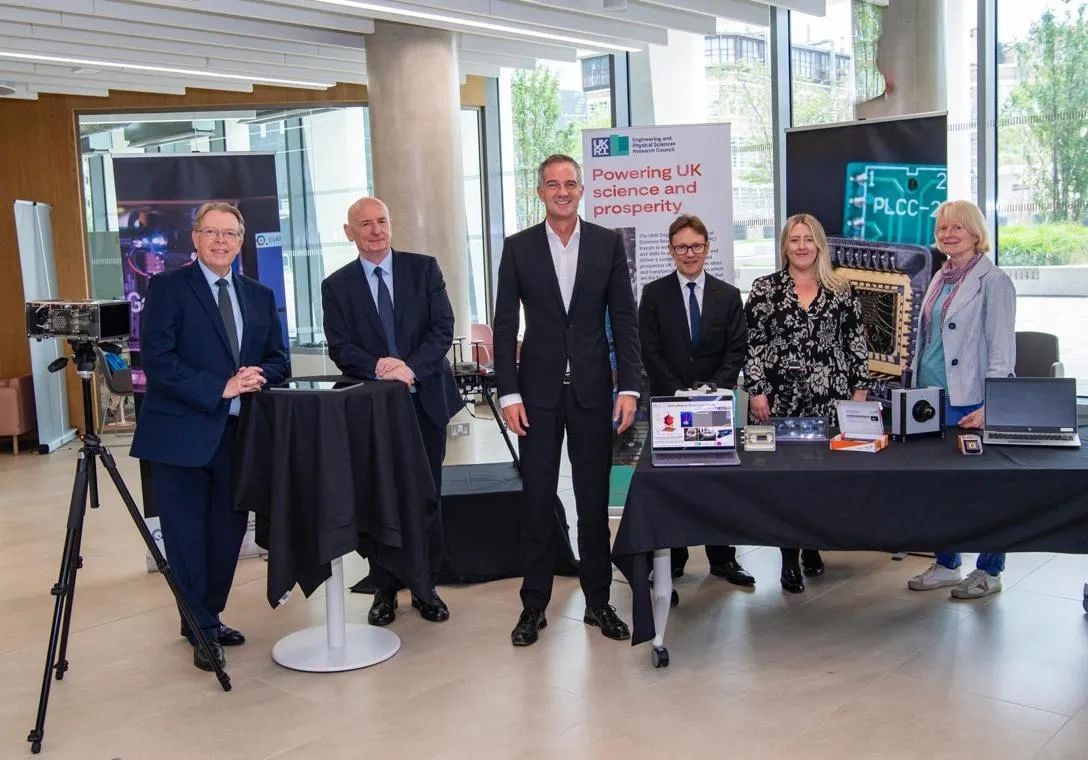
Pictured: Quentin Pankhurst (bio hub), Gerald Buller (IQN), Peter Kyle MP, Douglas Paul (PNT), Kirsty Annand (QuantIC/Quantum sensing and timing), Viv Kendon (Q Computing)

Secretary of State for Science, Innovation and Technology, Peter Kyle, said:

“We want to see a future where cutting-edge science improves everyday lives. That is the vision behind our investment in these new quantum technology hubs, by supporting the deployment of technology that will mean faster diagnoses for diseases, critical infrastructure safe from hostile threats and cleaner energy for us all.

“This isn’t just about research; it’s about putting that research to work. These hubs will bridge the gap between brilliant ideas and practical solutions. They will not only transform sectors like healthcare and security, but also create a culture of accelerated innovation that helps to grow our economy.”

As the UK aims to become a quantum-enabled economy by 2035, these hubs form a critical piece of the national quantum strategy. They are expected to drive entrepreneurship, workforce development, and regulatory input into the rapidly emerging UK quantum industry, potentially sparking significant economic growth and job creation in the coming years.

https://iqnhub.org/wp-content/uploads/2025/03/dr-fiona-fleming-optically-aligning-a-quantum-sensing-system.-credit-heriot-watt-university.x216f4a98.webp 720 1920 sxmwqjdi https://iqnhub.org/wp-content/uploads/2025/04/IQN-Logo_White-3.png sxmwqjdi2024-07-30 12:27:522025-05-07 20:55:41Heriot-Watt to lead quest for ‘near-unhackable’ quantum internet
Page 4 of 41234

Latest News & Events

  • Single-Photon Workshop delivers high-impact training for industry and academia3 March, 2026 - 3:30 pm
  • New PhD Opportunity in Quantum Networking26 February, 2026 - 9:43 am
  • 2026 Single Photon Workshop – Registration Open!11 February, 2026 - 3:27 pm
  • QNetworks 2026 – Registration now open29 January, 2026 - 10:08 am
  • Summer School Announcement18 January, 2026 - 4:36 pm

Integrated Quantum Networks Hub

Institute of Photonics and Quantum Sciences
Heriot-Watt University
Edinburgh, EH14 4AS
United Kingdom

Privacy Policy

  • Doc-text-inv Doc-text-inv
    Newsletter signup
  • Comment Comment
    Contact us
Linkedin Linkedin X-twitter X-twitter
Scroll to top Scroll to top Scroll to top

This site uses cookies. By continuing to browse the site, you are agreeing to our use of cookies.

Accept settingsDecline settingsSettings

Cookie and Privacy Settings


How we use cookies

We may request cookies to be set on your device. We use cookies to let us know when you visit our websites, how you interact with us, to enrich your user experience, and to customize your relationship with our website.

Click on the different category headings to find out more. You can also change some of your preferences. Note that blocking some types of cookies may impact your experience on our websites and the services we are able to offer.

Essential Website Cookies

These cookies are strictly necessary to provide you with services available through our website and to use some of its features.

Because these cookies are strictly necessary to deliver the website, refusing them will have impact how our site functions. You always can block or delete cookies by changing your browser settings and force blocking all cookies on this website. But this will always prompt you to accept/refuse cookies when revisiting our site.

We fully respect if you want to refuse cookies but to avoid asking you again and again kindly allow us to store a cookie for that. You are free to opt out any time or opt in for other cookies to get a better experience. If you refuse cookies we will remove all set cookies in our domain.

We provide you with a list of stored cookies on your computer in our domain so you can check what we stored. Due to security reasons we are not able to show or modify cookies from other domains. You can check these in your browser security settings.

Google Analytics Cookies

These cookies collect information that is used either in aggregate form to help us understand how our website is being used or how effective our marketing campaigns are, or to help us customize our website and application for you in order to enhance your experience.

If you do not want that we track your visit to our site you can disable tracking in your browser here:

Other external services

We also use different external services like Google Webfonts, Google Maps, and external Video providers. Since these providers may collect personal data like your IP address we allow you to block them here. Please be aware that this might heavily reduce the functionality and appearance of our site. Changes will take effect once you reload the page.

Google Webfont Settings:

Google Map Settings:

Google reCaptcha Settings:

Vimeo and Youtube video embeds:

Other cookies

The following cookies are also needed - You can choose if you want to allow them:

Privacy Policy

You can read about our cookies and privacy settings in detail on our Privacy Policy Page.

Privacy Policy
Accept settingsDecline settings